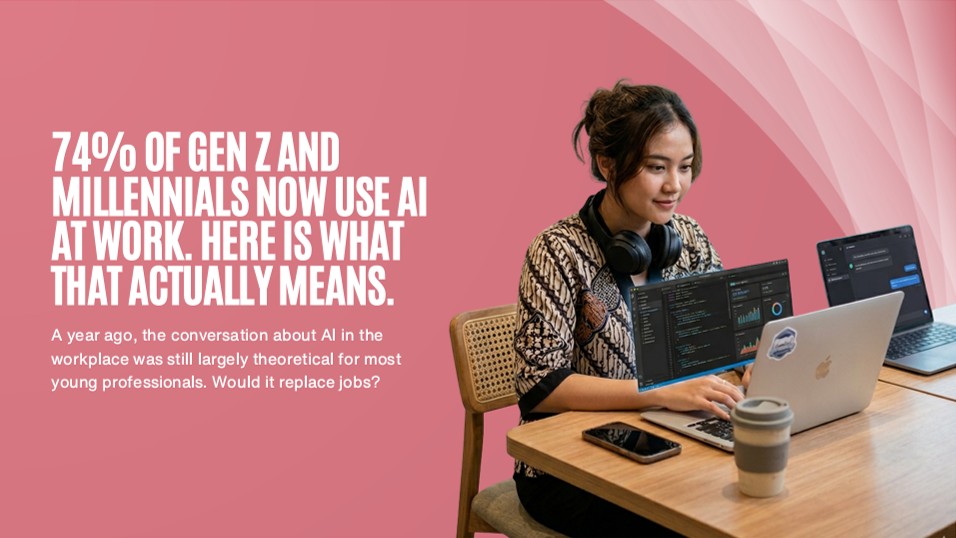
eloitte's 2026 Global Gen Z and Millennial Survey, drawing on responses from more than 22,500 participants across 44 countries, found that 74% of both Gen Z and millennial workers now use AI to some extent in their day-to-day work. Twelve months earlier, those figures stood at 57% and 56% respectively. The jump is not gradual adoption — it is mainstream arrival.
The Speed of the Shift
A 17 percentage point increase in AI adoption within a single year is significant by any measure. To put it in context: most major behavioral shifts in the workplace — the move to email, the adoption of smartphones, the normalization of remote work — took years or decades to reach comparable penetration. AI adoption at work among younger generations has compressed that timeline dramatically.
What is driving this acceleration is not just tool availability — AI tools have been widely accessible for several years. What changed is confidence and fluency. Gen Z and millennial workers have moved past the experimental phase. They are no longer testing AI to see what it can do. They are using it as a standard part of how they work, with enough familiarity to integrate it into real workflows rather than keeping it in a separate "AI projects" category.
Not a Threat — An Accelerator
One of the most persistent narratives around AI and employment is anxiety — the fear that AI will automate jobs out of existence, particularly at the entry level. The Deloitte survey data tells a more nuanced story. Gen Z and millennial workers largely view AI as an accelerant, not a threat. They expect it to free up time, improve the quality of their output, open new paths for career growth, and — crucially — create new opportunities specifically for entry-level workers.
Among those surveyed, AI enabling entry-level employees to gain experience faster was the most commonly cited positive impact, mentioned by 26% of Gen Z and 28% of millennial respondents. The second most common was AI allowing people to focus on higher-value work, cited by 25% of both generations. This is not the picture of a workforce bracing for displacement. It is a workforce that has found a way to use AI to accelerate their own development.
That reframing matters. The workers who approach AI as a tool for personal acceleration — learning faster, producing better work, taking on more complex tasks sooner — are building a fundamentally different professional trajectory than those who are waiting to see how it all plays out. The data suggests that younger workers are, on the whole, choosing the former.
Beyond Productivity: AI as a Career Development Tool
What makes the 2026 picture particularly interesting is how Gen Z and millennial workers are using AI — and what categories of use have expanded beyond the obvious. Productivity applications remain central: drafting, summarizing, researching, and automating repetitive tasks. But the survey found that AI usage has extended into territory that was largely unexpected two years ago.
Workers in this demographic are using AI for learning and skill development, for career guidance and planning, and for stress and well-being management. The tool has become part of how they navigate professional uncertainty — not just how they complete tasks. A Gen Z employee using AI to prepare for a difficult performance conversation, or to help them understand a new industry they are trying to enter, is using the technology in a way that compounds over time.
This breadth of application is significant. It means the value of AI fluency is not confined to specific job functions or industries. It extends across the full arc of career development — and the workers who develop that fluency early are building a durable advantage.
The Organizational Gap
There is a tension embedded in the Deloitte findings that deserves attention. Despite high adoption rates, many Gen Z and millennial workers feel that they are adapting to AI faster than their organizations. Their personal fluency has outpaced the institutional infrastructure meant to support it. Less than half of respondents said their employers provided sufficient AI tools, and the gap between individual adoption and organizational readiness is a recurring theme in the data.
For individual professionals, this gap creates both a frustration and an opportunity. The frustration is real — workers who want to apply AI skills in their current roles often face organizational inertia, restricted tool access, or managers who are not yet comfortable with AI-augmented workflows. But the opportunity is equally real: the individuals who are already fluent in AI are positioned to lead the organizational adoption curve when it eventually catches up. In fast-moving industries, that positioning can define careers.
What This Means If You Have Not Started Yet
The 26% of Gen Z and 26% of millennial workers who are not yet using AI at work are not a stable category. The trajectory of adoption — 57% to 74% in twelve months — suggests that the non-adopter group will continue to shrink rapidly. What is today an optional enhancement is becoming a standard professional expectation, and the timeline for that transition is compressing.
The practical implication is not that everyone needs to become an AI engineer. It is that every professional needs to have a working relationship with AI tools that is relevant to their field. A marketer who does not use AI in their content and research workflow is operating at a systematic disadvantage compared to one who does. A project manager who has not explored AI for planning and synthesis is leaving efficiency on the table. The specific tools matter less than the habit of using them.
The 61% of Gen Z workers who believe AI skills are essential for career advancement are not expressing anxiety — they are expressing a correct read of the direction things are moving. The question for the remaining 39% is not whether that read is accurate, but whether they will act on it before the gap becomes harder to close.
Adapting Faster Than the System
The most revealing finding in the Deloitte 2026 data is not the adoption rate itself — it is the mismatch between how quickly individuals are moving and how slowly institutions are following. Gen Z and millennial workers are not waiting for their employers to figure out AI strategy before they develop their own capabilities. They are building fluency independently, often with tools they sourced and learned outside of any official training program.
That pattern — individual adaptation outpacing institutional readiness — is the defining characteristic of how this generation navigates technological change. It was true with social media, with remote work tools, and with the broader digital economy. AI is the latest and most consequential example. The workers who recognize this dynamic and move early are the ones who tend to define what comes next.
Ready to work smarter? Start today.